Youth Unemployment in Europe in 2026: Where Starting a Career Is Hardest

Nearly 3 Million Young Europeans Are Without Work
According to Eurostat, 2,987 million young people under 25 were unemployed across the EU in June 2026. In the euro area, that figure was 2,351 million.
These numbers are measured using the International Labour Organization (ILO) definition: a person is counted as unemployed only if they are aged 15 to 74, had no work during the reference week, are available to start work within the next 2 weeks, and have actively sought employment at some point during the last 4 weeks. Students who are not actively job-seeking are not captured by this measure, so the figures reflect people who are genuinely trying to enter the labour market.
The Youth Rate vs. the Overall Rate
The EU youth unemployment rate stood at 15.5% in June 2026, up from 15.4% in May 2026. In the euro area, the rate was 14.8% in June 2026, down slightly from 14.9% in May 2026.
For comparison, the overall EU unemployment rate was 6% in June 2026. In the euro area, the overall rate was 6.3%. By sex, the euro area rate for women was 6.4% and for men it was 6.2% in June 2026.
The difference between the youth rate and the overall rate is considerable. Eurostat's analysis notes that youth unemployment appears to be more susceptible to cyclical economic changes than overall unemployment.
Has It Been Getting Better or Worse?
Compared with May 2026, youth unemployment in the EU increased by 29,000. In the euro area, the figure was unchanged over the same month.
Looking year on year: compared with June 2025, youth unemployment increased by 53,000 across the EU. In the euro area, it decreased by 8,000 over the same period.
The EU-wide trend is moving upward both month on month and year on year. The euro area picture is more stable, showing a small improvement when measured against June 2025.
What the Data Covers - and Where Its Limits Are
The EU data covers all 27 member states. The euro area figures cover 21 countries. However, Eurostat notes that the methodology varies by country: for some member states, monthly labour force survey data feeds directly into the estimates, while for others Eurostat calculates monthly figures from quarterly survey results. The most recent figures are also noted to be usually provisional. This means the recency and method of the underlying data is not uniform across countries.
Eurostat publishes unemployment figures by gender and for two age groups - those aged 15 to 24 years, and those aged 25 to 74 years - but the reliability of country-level figures depends on the inputs available for each member state.
Starting Your Career in This Environment
A youth unemployment rate of 15.5% across the EU in June 2026 means a significant share of active under-25 job seekers are still looking. Total EU unemployment across all ages reached 13,317 million people in June 2026, of which 11,130 million were in the euro area.
Europe is not a single labour market. Each of the 27 EU member states has different industry demand, qualification recognition systems, and hiring conditions. For young job seekers, one practical response is to search across borders - looking beyond your home country can open up markets where conditions are more favourable.
NewLuxJob covers professional roles across EU countries, with filters by country, sector, and career level. If you are early in your career and weighing where to apply, searching across multiple EU markets gives you a clearer picture of where demand actually is.
Share this article
Check today’s jobs in your field
AI-Powered
Get a professional Cover Letter via AI
Pick a job from your matches and get a cover letter written for it in minutes. Your first one is free.
Write my cover letterRelated Articles
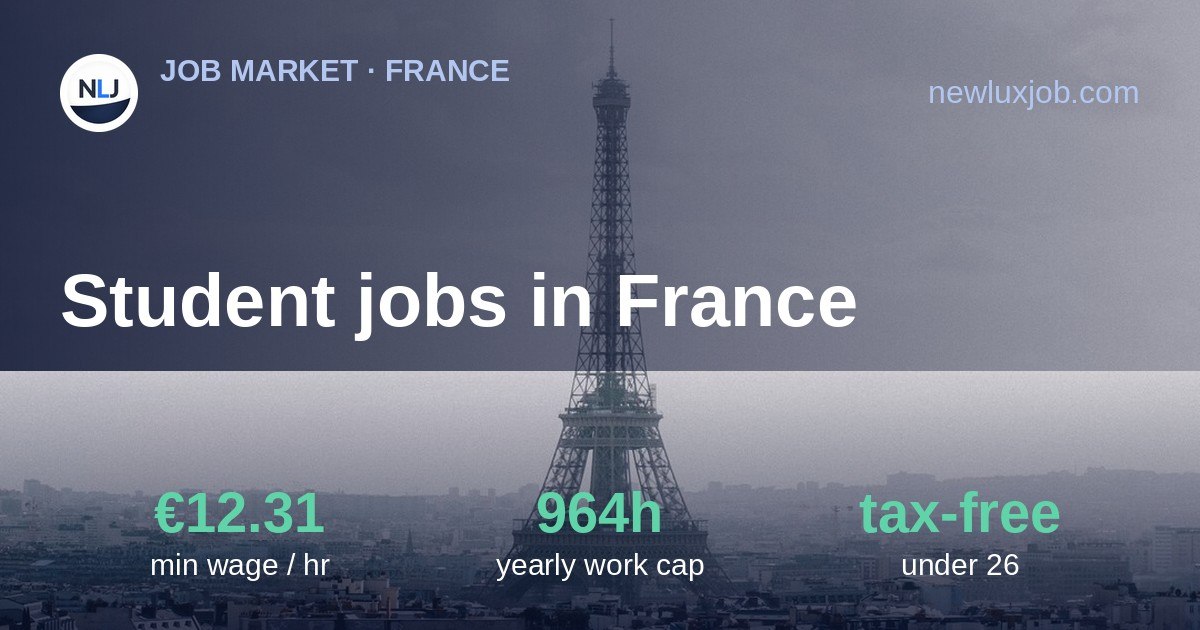
Student jobs in France: hours, pay, and how to find one in 2026
Working while studying in France, explained: the 964-hour rule, what you earn on the minimum wage, the contracts to look for, and where to find openings now.
Which jobs are open in Ireland, 15 October 2026
15 sections, 4 687 open jobs, counted on 15 October 2026. Every link goes to the page the number came from.