EU Minimum Wages in 2026: Which Countries Pay the Most?
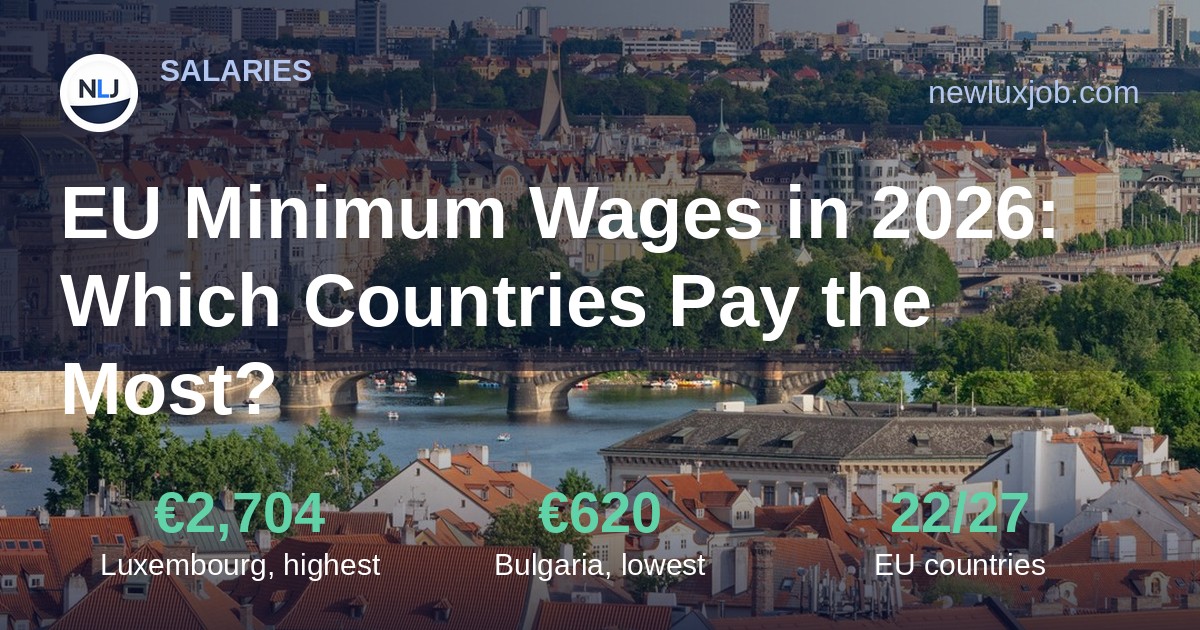
If you are comparing job offers across Europe, the legal minimum wage is a useful starting point - but it varies considerably by country. According to Eurostat, 22 out of 27 EU member states had a national minimum wage in 2026. Denmark, Italy, Austria, Finland and Sweden did not.
The spread across the 22 countries that do have a statutory floor is wide. The highest minimum wage was 4.4 times the lowest in nominal terms.
All figures are gross monthly amounts - before tax and employee social security contributions are deducted.
Countries paying the highest minimum wages
6 EU countries had minimum wages above €1,500 per month in 2026:
- Luxembourg: €2,704
- Ireland: €2,391
- Germany: €2,343
- Netherlands: €2,295
- Belgium: €2,112
- France: €1,823
Where the minimum wage is set on an hourly basis - as in Germany, France, Ireland and the Netherlands - Eurostat converts the hourly rate to a monthly equivalent for comparison.
The middle band: €1,000 to €1,500 per month
8 countries had minimum wages between €1,000 and €1,500 per month: Greece (€1,027), Croatia (€1,050), Portugal (€1,073), Cyprus (€1,088), Poland (€1,139), Lithuania (€1,153), Slovenia (€1,278) and Spain (€1,381).
Two methodological notes from Eurostat apply here. First, the figures for Slovenia and Spain reflect 2025 levels, because 2026 rates were not available at publication. Second, Greece, Spain and Portugal pay their minimum wage for 14 months a year; Eurostat adjusts those figures to a standard monthly amount.
Below €1,000: the lowest floors in the EU
8 EU countries had minimum wages below €1,000 per month:
- Bulgaria: €620
- Latvia: €780
- Romania: €795
- Hungary: €838
- Estonia: €886
- Slovakia: €915
- Czechia: €924
- Malta: €994
After adjusting for prices, the gap shrinks
Nominal euro figures do not account for the fact that living costs differ across EU countries. Eurostat also measures minimum wages in purchasing power standard (PPS), which adjusts for price level differences.
In PPS terms, the gap between the highest and lowest minimum wages falls from 4.4 times to 2.4 times. Figures range from PPS 886 per month in Estonia to PPS 2,157 in Germany.
In PPS terms, 3 groups emerge:
- Above PPS 1,500: Germany, Luxembourg, the Netherlands, Belgium, Ireland, France, Poland and Spain.
- Between PPS 1,000 and PPS 1,500: Slovenia, Lithuania, Croatia, Romania, Portugal, Greece, Cyprus, Hungary, Malta, Slovakia, Bulgaria and Czechia.
- Below PPS 1,000: Latvia and Estonia.
Compared with 2025, Slovakia, Bulgaria and Czechia moved into the middle group - their purchasing-power-adjusted minimum wages crossed the PPS 1,000 threshold in 2026.
Searching for jobs across Europe?
NewLuxJob lists vacancies across the EU at all salary levels. Use the minimum wage figures above as a legal baseline when reviewing offers - and keep in mind that the PPS data shows the real value of a salary depends on where you will be living and spending.
Source: Eurostat
Comparte este artículo
Centro de conocimiento
Prueba el Coach con IA de NewLuxJob
Recibe un informe profesional personalizado con IA en tu cuenta de NewLuxJob
Empieza gratisArtículos relacionados

European Labour Costs Are Rising Fast: The Q1 2026 Numbers
Hourly labour costs across the EU rose 3.6% in Q1 2026, with construction posting the fastest sector gain at 4.2%, according to Eurostat's Labour Cost Index. Here is what the data shows.
European Wages and Labour Costs: A Country-by-Country Breakdown
Eurostat data shows hourly labour costs ranging from €12 in Bulgaria to €56.8 in Luxembourg in 2025, with wide gaps in median earnings and low-wage rates across EU member states.