What Employers Pay Per Hour Across Europe - and Why It Matters to Your Job Search

Understanding what an hour of work costs an employer - across all 27 EU member states - puts salary differences in context. Gross pay is only part of the picture; on top of it, employers pay social contributions and other non-wage items that vary by country.
Eurostat publishes EU-wide estimates for hourly labour costs each year. The 2025 figures cover enterprises with 10 or more employees and are based on the 2020 Labour Cost Survey, extrapolated using the Labour Cost Index. Here is what the data shows.
The range: from €12 to €56.8 per hour
In 2025, average hourly labour costs across the EU were estimated at €34.9. In the euro area - a bloc of 21 countries - the average was €38.2 per hour.
Those averages mask wide differences between countries. The lowest hourly labour costs were recorded in Bulgaria (€12), Romania (€13.6) and Hungary (€15.2). The highest were in Luxembourg (€56.8), Denmark (€51.7) and the Netherlands (€47.9).
The gap between the least expensive and most expensive EU labour markets is considerable, reflecting differences in both wage levels and non-wage employer costs across member states.
What goes into the hourly cost
Labour costs have two main components: wages and salaries, and non-wage costs such as employers' social contributions. In 2025, non-wage costs made up 24.8% of total hourly labour costs in the EU, and 25.6% in the euro area.
That means a notable portion of what an employer pays per hour does not appear in an employee's gross salary - it goes to social contributions and related items. This is part of why the total cost of employing someone can differ from what a job seeker sees in an offer letter.
How costs vary by sector
Across the EU in 2025, hourly labour costs were highest in the mainly non-business economy (excluding public administration) at €35.5 per hour. Construction was the lowest-cost sector at €31.5 per hour.
Within the euro area, the range was wider. Industry posted €40.3 per hour, while construction came in at €34.4 per hour.
The fastest-rising markets in 2025
Between 2024 and 2025, hourly labour costs rose 4.1% across the EU and 3.8% in the euro area.
Not all markets rose at the same pace. Within the euro area - calculated in its current composition, which includes Bulgaria - the largest increases were in Bulgaria (+13.1%), Croatia (+11.6%), Slovenia (+9.3%) and Lithuania (+9.2%). Italy recorded an increase of 3.2%. Spain (whose 2024 figures are based on national sources), Cyprus and Luxembourg each saw 3.5%. Malta, whose 2025 data are benchmarked on the 2016 Labour Cost Survey pending further analysis, was the only country to see costs fall, by 0.5%.
For EU countries outside the euro area, Eurostat reports growth in national currencies - figures that are influenced by exchange rate movements. Among those countries: Romania rose 10.6%, Hungary 8.9% and Poland 8.8%.
What job seekers can take from this
Labour cost data is relevant to job seekers because it sits behind the economics of hiring across Europe.
The gap between a €12 per hour employer cost in Bulgaria and a €56.8 per hour cost in Luxembourg reflects both wage levels and the non-wage component - social contributions and related employer-side costs - that stack on top of any salary offer. Understanding this helps explain why compensation benchmarks for comparable roles can differ so significantly between markets.
For anyone tracking fast-moving markets: Bulgaria and Croatia both saw double-digit increases in hourly labour costs between 2024 and 2025, well above the EU average of 4.1%. Those shifts are part of the broader labour cost picture across the bloc.
You can browse current vacancies across European markets on NewLuxJob.
Diesen Artikel teilen
Heutige Stellen in Ihrem Bereich ansehen
KI-gestützt
Professionelles Anschreiben mit KI
Wählen Sie eine Stelle aus Ihren Treffern und erhalten Sie in wenigen Minuten ein passendes Anschreiben. Das erste ist kostenlos.
Anschreiben erstellenÄhnliche Artikel
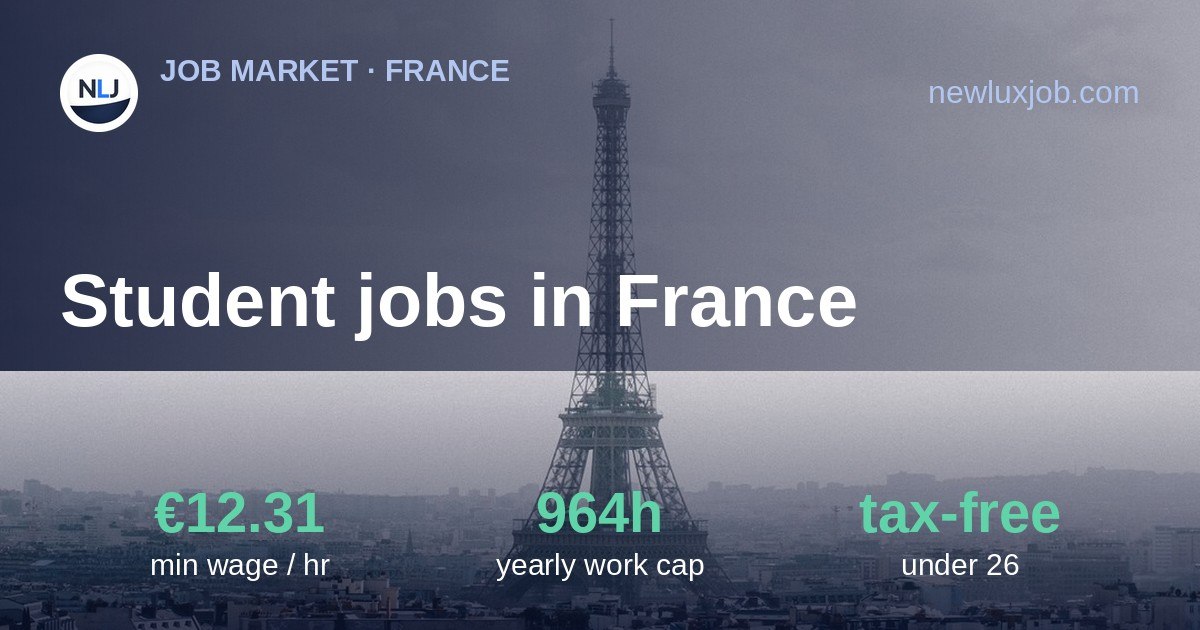
Student jobs in France: hours, pay, and how to find one in 2026
Working while studying in France, explained: the 964-hour rule, what you earn on the minimum wage, the contracts to look for, and where to find openings now.
Which jobs are open in Italy, 16 October 2026
15 sections, 3 826 open jobs, counted on 16 October 2026. Every link goes to the page the number came from.